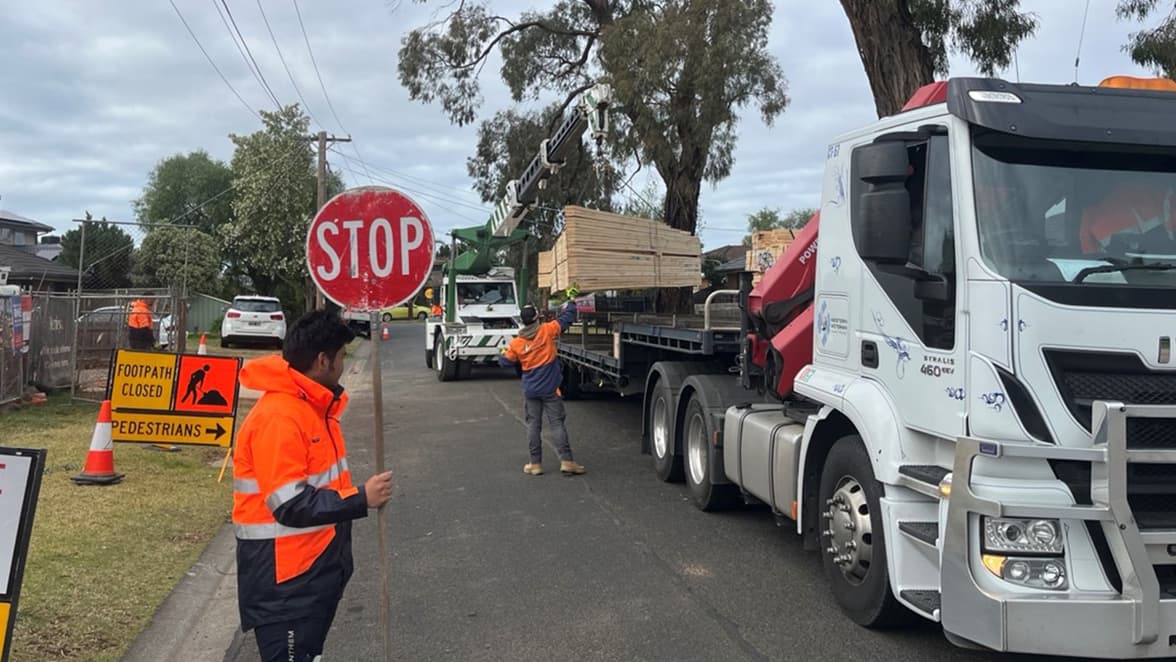
When you picture your home being built, you probably think about floorplans, colour selections and a finished frame that seems to magically appear on your block. What you might not picture is a queue of concrete trucks parked down your street in peak hour, or a 30m tall crane carefully manoeuvring structural materials into position.
Welcome to another instalment of Building, Decoded, our series designed to unpack the often-unseen aspects of the homebuilding journey. This time, we're looking at traffic management and why it's an essential part of keeping your build safe, compliant and on track.
An allowance for traffic management is typically added to your sales quote, tender and contract. Sometimes this provisional amount can be quite significant, so we often get lots of questions around why it's needed and where the cost comes from. In this article, we'll help you understand just that.

Building a home requires a constant flow of people, materials and equipment to and from your site.
Take your slab pour, for example. On a busy pouring day, there could be six or more large concrete trucks arriving at your site, along with a truck-mounted pump used to pour the concrete foundations of your home. Later in the build, deliveries of bulky building materials, like timber trusses, may require a crane to unload and position materials safely.
While these activities are all critical to building your home, they can temporarily affect normal traffic conditions in your street. Large vehicles may occupy roadside parking, require additional space to manoeuvre, or create temporary disruptions for motorists, cyclists and pedestrians.
Without appropriate planning and controls, these situations can increase the risk of congestion, confusion and safety incidents. That's where traffic management comes in.

Why traffic management matters
At its core, traffic management is about ensuring construction activities can take place safely while minimising disruption to the surrounding community.
A well-planned traffic management strategy helps protect workers, residents, neighbours and road users by ensuring vehicles, pedestrians and construction activities can safety coexist throughout the build process.
It's important to understand that traffic management is just as necessary on a quiet street with ample parking, as it is on a main road or near a school.
It's also about keeping your project moving.
If access to your site isn't properly organised, or if the required approvals haven't been obtained, construction activities can be delayed or even halted. In some cases, failing to meet traffic management requirements can result in fines, project delays or stop-work directions.
In other words, good traffic management doesn't just protect the public. It helps protect your build timeline too.

What's involved?
Traffic management is far more than simply putting out a few cones and signs.
Before major construction activities can occur, careful planning is often required to assess site-specific risks and determine how vehicles, equipment and pedestrians will safely move around the area.
This can include:
- Obtaining permits and approvals from local councils or VicRoads, depending on the location and type of road affected.
- Assessing site access, parking availability, traffic flow and pedestrian movement.
- Planning temporary traffic measures such as signage, barriers, lane closures or detours where required.
- Coordinating access for specialised equipment, including cranes and concrete pumps.
- Creating suitable work zones for trades and deliveries.
- Communicating with neighbours and nearby residents about planned disruptions.
Each site is different, which means traffic management requirements can vary significantly depending on the location, surrounding roads and construction activities taking place.
The good news? We handle it for you.
From coordinating permits and approvals to arranging the necessary traffic controls for major construction activities, our team works to ensure your build remains safe, compliant and running as smoothly as possible.

If we don’t require the full provisional amount allowed for traffic management, the unused value will be deducted from your contract and put back in your pocket at the end of construction, prior to settlement. This is quite a common occurrence. Our approach ensures that there are no nasty surprises once your build begins, as all possibilities have been considered early.
Traffic management is one of the many behind the scenes elements involved in delivering your new home, but it plays an essential role in helping construction progress efficiently while minimising disruption to the local community.
Because while traffic management may not be the most exciting part of building a home, it's one of the countless moving parts that helps turn a set of plans into a place you'll call home.
Building, Decoded is Henley's series dedicated to explaining the terminology, regulations and processes behind building a new home, helping you make informed decisions with confidence.